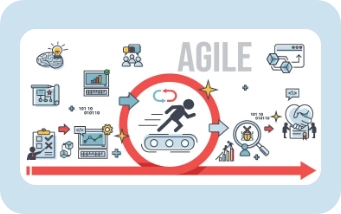
What is Agile Project Management?
Agile project management is a flexible and collaborative approach to project execution and product development. It emphasizes adaptability, customer-centricity, and continuous improvement.
Agile project management and its core principles.

Agile project management is guided by several fundamental principles
1. Customer Collaboration Over Contract Negotiation
Agile prioritizes open communication with stakeholders, emphasizing their involvement throughout the project. This ensures that the end product aligns with customer needs and expectations.
2. Responding to Change Over Following a Plan
Agile acknowledges that project requirements can evolve. It values the ability to adapt to change over rigidly sticking to initial plans. This responsiveness allows teams to adjust course when necessary to deliver the most valuable product.
3. Working Solutions Over Comprehensive Documentation
While documentation is essential, Agile places a higher value on delivering a working product. Teams focus on creating functional solutions and use documentation as needed to support development.
4. Collaboration and Individuals Over Processes and Tools
Agile places a strong emphasis on teamwork and individual interactions. It values people and their ability to collaborate effectively, recognizing that processes and tools should facilitate, not hinder, the team’s efforts.
The Iterative and Incremental Approach

1. Iterative:
Agile project management divides the project into smaller cycles, known as iterations or sprints. During each iteration, a part of the project is developed and refined. Iterations are short, typically lasting 1-4 weeks, allowing for frequent inspection and adaptation.
2. Incremental
Agile emphasizes the delivery of incremental value to customers. This means that after each iteration, a potentially shippable product increment is produced. These increments build upon one another, steadily improving the product’s functionality.
The Agile Manifesto and Its Values
The Agile Manifesto
The Agile Manifesto is a foundational document that outlines the values and principles of Agile project management. It was created by a group of software developers in 2001 but has since been applied to various industries.

Values of the Agile Manifesto
1. Individuals and Interactions Over Processes and Tools
Agile values people and their ability to collaborate effectively. It emphasizes direct communication and teamwork.
2. Working Solutions Over Comprehensive Documentation
While documentation is important, Agile prioritizes delivering functional solutions. Documentation should support development, not be the primary focus.
3. Responding to Change Over Following a Plan
Agile acknowledges that change is inevitable. It values the ability to adapt to evolving requirements and priorities.
4. Customer Collaboration Over Contract Negotiation
Agile encourages close collaboration with customers and stakeholders. Their feedback and involvement are critical to the project’s success.
5. Principles of the Agile Manifesto
In addition to these values, the Agile Manifesto includes 12 guiding principles that provide more specific guidance on how to apply Agile principles effectively in project management.
Traditional Project Management
In addition to these values, the Agile Manifesto includes 12 guiding principles that provide more specific guidance on how to apply Agile principles effectively in project management.

Traditional project management, often associated with methodologies like Waterfall, follows a linear and sequential approach to project execution.
It involves the following characteristics
1. Sequential Phases
Projects are divided into discrete phases (e.g., requirements, design, development, testing) that are executed sequentially.
2. Comprehensive Planning
Detailed planning is conducted at the beginning of the project, and changes to the plan are discouraged.
3. Limited Customer Involvement
Customer feedback is typically sought at the beginning and end of the project, with minimal involvement during development.
4. Emphasis on Documentation
Extensive documentation is created at each phase of the project to define requirements, design specifications, and more.
Comparison Between Agile and Traditional Project Management

1. Flexibility
Agile is highly flexible and adaptive, making it suitable for projects with evolving requirements. Traditional project management is less flexible and is better suited for projects with well-defined and stable requirements.
2. Customer Involvement
Agile encourages continuous customer involvement throughout the project, while traditional methods involve customers mainly at the beginning and end.
3. Iterative vs. Sequential
Agile employs an iterative and incremental approach, allowing for the development of a usable product early in the project. Traditional methods follow a sequential path, with the product delivered at the end.
4. Change Management
Agile embraces change and treats it as an opportunity. Traditional project management treats change as a risk and seeks to avoid it.
Limitations of Traditional Approaches in Non-IT Industries
Traditional project management methods, while suitable for certain industries and projects, have limitations in non-IT sectors
Non-IT industries often encounter changing market conditions and customer demands. Traditional methods may struggle to adapt to these changes.
2. Limited Customer Involvement
In industries like healthcare and manufacturing, customer or stakeholder needs may evolve over time. Traditional approaches might not capture these changes effectively.
3. Risk of Late Discoveries
Traditional methods may lead to the discovery of critical issues or defects late in the project, which can be costly to address.
Agile in Non-IT Industries
Benefits of Agile in Non-IT Sectors

Agile methodologies offer several distinct advantages when applied to non-IT industries
1. Adaptability
Non-IT industries often face changing regulatory environments, shifting consumer preferences, and evolving market dynamics. Agile’s iterative and incremental approach allows organizations to respond swiftly to these changes by adjusting project priorities and features as needed.
2. Customer-Centric Focus
Agile places a strong emphasis on involving customers or end-users in the project. This ensures that the final product aligns closely with customer needs and expectations, leading to higher satisfaction levels.
3. Faster Time-to-Market
Agile’s iterative delivery model allows for the release of incremental product increments at the end of each iteration. This means that usable portions of the project can be delivered faster, enabling organizations to enter the market more quickly.
4. Enhanced Collaboration
Agile promotes collaboration among cross-functional teams, breaking down silos that can hinder progress in non-IT sectors. This leads to improved communication, shared responsibility, and a more cohesive approach to project execution
Successful Agile Implementations in Non-IT Sectors
To illustrate the effectiveness of Agile in non-IT industries, here are some real-world examples
1. Manufacturing
An automotive manufacturer adopted Agile principles to redesign its production process. They used Agile methodologies to identify and address bottlenecks in the assembly line, resulting in a significant increase in production efficiency and a reduction in defects.
2. Healthcare
A hospital implemented Agile practices to improve patient care. Agile allowed the hospital to adapt to changing patient needs more effectively. For example, they used Agile to redesign their appointment scheduling system, reducing patient wait times and improving overall satisfaction.
3. Finance
A financial institution used Agile to streamline their loan approval process. By breaking down the process into iterative stages, they could respond faster to regulatory changes and customer demands. As a result, loan approval times were reduced, and customer satisfaction increased.
4. Government
A government agency applied Agile methodologies to project management. They found that Agile improved collaboration among different departments, allowed for more flexibility in addressing citizen needs, and enhanced transparency in project execution.
Implementing Agile in Non-IT Projects
Popular Agile Frameworks
Agile offers a variety of frameworks that organizations can choose from to implement Agile principles effectively in non-IT projects.
Some of the most widely used frameworks include

1. Scrum
Scrum is a popular Agile framework characterized by its iterative and time-boxed approach. It divides work into short development cycles called sprints, typically lasting two to four weeks. Scrum provides a structured framework for planning, executing, and reviewing work, making it suitable for various non-IT projects.
2. Kanban
Kanban is an Agile framework that focuses on visualizing work and optimizing workflow. It uses boards and cards to represent tasks and their progress. Kanban is highly adaptable and is often used in non-IT sectors for managing production processes, supply chains, and service delivery.
3. Lean
Lean principles aim to eliminate waste and deliver value efficiently. While Lean is not a strict Agile framework, its principles align well with Agile methodologies. Lean thinking can be applied in non-IT industries to reduce inefficiencies, improve process flow, and enhance customer value.
Frameworks Tailored to Non-IT Projects
Agile frameworks are not limited to IT projects; they can be tailored to suit the specific needs of non-IT projects.
This adaptation involves customizing Agile practices and terminology to align with the industry’s unique requirements. For example:
- In manufacturing, Scrum principles can be adapted to optimize production processes, manage inventory, and reduce defects.
- In healthcare, Kanban boards can be used to visualize patient flow and optimize hospital operations.
- In finance, Lean principles can be applied to streamline approval processes and reduce financial waste.
Here are examples of how Agile frameworks have been adapted in different non-IT industries:
1. Manufacturing
A manufacturing company adopted Scrum to manage the development of new product lines. They used sprints to design and test prototypes, resulting in faster time-to-market and reduced production costs.
2. Healthcare
A hospital implemented Kanban to improve patient care. They customized Kanban boards to visualize patient flow, optimize bed allocation, and streamline discharge processes, leading to reduced patient wait times and improved care quality.
3. Finance
A financial institution applied Lean principles to enhance loan approval processes. They identified and eliminated non-value-added steps, reducing approval times and increasing customer satisfaction.
Steps to Introduce Agile Methodologies
Introducing Agile methodologies in non-IT projects involves the following steps:
1. Assessment
Assess the organization’s readiness for Agile adoption and identify areas where Agile can be most beneficial.
2. Training
Provide Agile training to team members and stakeholders to ensure they understand Agile principles and practices.
3. Pilot Projects
Start with small-scale pilot projects to test Agile practices and gain experience.
4. Continuous Improvement
Encourage continuous improvement by conducting retrospectives after each iteration or project to identify areas for enhancement.
Importance of Team Training and Cultural Alignment
Team training is essential for successful Agile implementation in non-IT projects. It ensures that team members understand Agile principles, roles, and responsibilities. Additionally, cultural alignment is crucial.
The organization’s culture should support Agile values such as collaboration, adaptability, and customer focus.
Selecting the Right Agile Framework
Choosing the appropriate Agile framework for specific non-IT projects is essential. Consider factors such as project complexity, team size, industry requirements, and project goals when selecting a framework.
For example, Scrum may be more suitable for well-defined, structured projects, while Kanban may be a better fit for projects with continuously changing requirements.