
Explore and understand the most crucial phase of the Project Management Lifecycle in this chapter – Project Planning. Planning in any endeavor is an extensive exercise.
Project Planning results in lots and lots of plan and when all these individual plan come together, you see the grandiose image of your end objective.
This master plan gives you a clear picture of your product or service once you execute all your plans in letter and spirit.
In very simple terms, by the end of the Project Planning phase you come to know
- What will be delivered
- When will it be delivered
- How will you get it
- Who will help you get
- How much will you have to spend
- What risks can impact your end result
- How to handle those risks
Thus essentially the single most important output of Project Planning is – “Project Management Plan”.
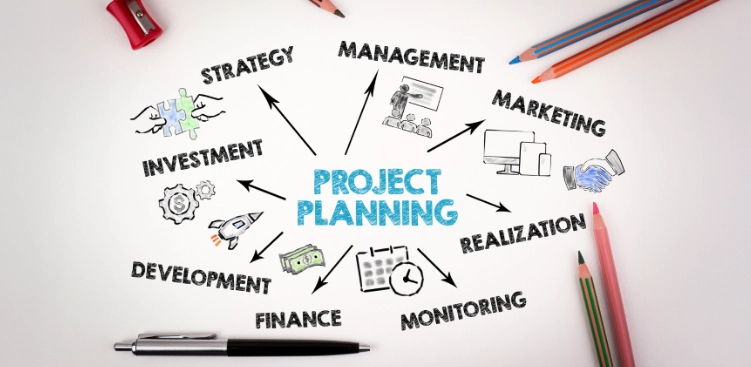
Project Management Plan consists of multiple other plans that cover your stakeholders, requirements, scope, deliverables, resources, staffing, vendors and procurement, quality, costs and risks etc. A project management plan would majorly consist of:
- Communication management plan
- Project scope management plan
- Schedule management plan
- Staffing management plan
- Quality management plan
- Risk management plan
- Cost management plan
- Process improvement plan
- Procurement management plan
“if you do not know where you are going you neither know how to get there nor even when you have arrived!”
Project Management Plan
The Project Plan is the living document of your project. It is your “single source of truth” as it has everything that the project is about!
All project participants, contributors, impacted parties etc. are listed in the project management plan. It is the guiding light if you may that steers your project through execution, implementation, monitoring, governance & control.
It is the bible that houses each and every change, amendment made to the project through execution along with the entire scope, schedule and associated costs.
Note: The Project Manager is the author of the Project Management plan and he takes inputs from the project charter, business case in consultation with the subject matter experts (SMEs), project teams, stakeholders, sponsors and senior leaders as applicable.
As the Planning phase progresses the Project Manager is required to
- Define baselines in terms of scope, time and cost
- Review the baselines with the project stakeholders and obtain approvals
- Define and agree on the governance model to be followed for the project
- Receive approvals for the relevant resources and staffing
- Define and share the communication management plan
- Maintain the project mgmt. plan up to date to reflect every approved change made to the original plan.
Nevertheless, getting each and every vital info recorded, reviewed and shared is a tiring job and the project success is hugely dependent on the Planning phase. A poorly drafted project management plan is the sure shot recipe for absolute failure.
And it is pretty evident that matured organizations spend a huge amount of time and efforts to ensure they have a solid plan before they begin execution.
Communication Management Plan
Communication if well managed can work wonders for you and your team. It is always recommended that you set some ground rules around project activity communication.
Everyone in the team MUST know the “authorized” recipients of the information along with the expected timelines and intervals for every project communication.

For any communication plan to be effective it must
- Address the stakeholder expectations
- Ensure the involved project participants receive the right info at the right time
- Facilitates team collaboration and prevents communication breakdown at all times
- Have well defined Communication format, modes, frequency and audience
We must also remember that “one size fits all” never applies to project communication. For example, the project sponsor does not care about the number of lines of code written so far.
Also, make sure that your Communication Plan clearly indicates any assumptions and constraints taken into account. And we must update the plan as when these constraints are removed and assumptions clarified.
Project teams perform better when they review and share real-time project progress and status. With timely insights, they can take corrective actions, make informed decisions, and guide the project toward success.
Schedule Management Plan
We all know that project is an endeavor that must have a definite start and end. Thus it entails that each and every task required to complete the project must therefore have defined state and end too.
Schedule Management Plan (SMP) includes the list of activities that will be performed during the course of the project by specified resources within timelines.
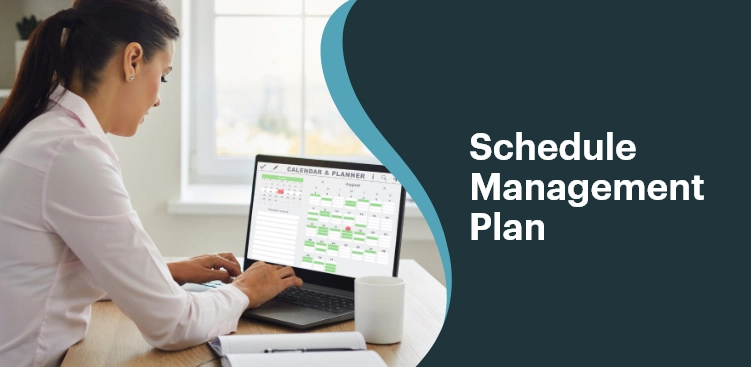
The SMP clearly defines what we need to do, who will do it, and when they will do it. We may not always create an exact schedule, but we do build a broad view of available resources and the time required to complete each activity. This helps us establish a general baseline and timeline for the project.
There are various mechanisms and techniques used across organizations to define and maintain project schedule and the most widely used ones are Gantt Charts and Critical Path Method (CPM).
Developing the Project Schedule is the worst nightmare a project manager can have. Estimating the “right” time requirement for each activity is critical. One need to pay attention to every tiny detail involved to make as accurate an estimation possible.
If you allocate very tight timelines then you have a team working under a lot of stress and pressure leading to quality loss. It’s a given because of the simple fact that – Focus shifts from getting the task over than getting it done with quality.
Similarly if you are too lax and add an unreasonable buffer the entire project budget is skewed. So either ways the Project Manager is between a hard surface and a rock!
A detailed Work Breakdown Structure (WBS) breaks down each activity into manageable tasks to ensure transparency and accountability. When we lay out the WBS clearly, we avoid missing key activities and prevent negative impacts on time and cost. Estimating smaller tasks is always easier than estimating large ones, which improves our chances of creating accurate and reliable time and cost estimates.
Task dependencies are another important aspect. Once you start breaking down your tasks, you can easily relate to the sequences of those individual chunks and also linkages and interdependencies among them. This helps you understand which activities can be done simultaneously & which will be done later thereby giving you a thorough glimpse of your resource and time requirements.
Upon completion of the above 2 activities you now need to focus on Time and Resource Estimation. Here comes the critical aspects of expertise, productivity and unforeseen events. A seasoned Project Manager would definitely account for skillfulness of the resources involved, perceived risks, leaves and holidays along with resource availability. Risks and Resource Availability are significant factors that have a direct impact on your project progress and delivery. You must account for the unavailability of key resources during the project, as less skilled team members may step in. Although this may slightly reduce costs, it affects the project timelines.
But rest assured — when you address the above three factors in your Schedule Management Plan, you set yourself up for an on-time and within-budget project delivery without compromising quality.
Resource & Staffing Management Plan
Resources are the backbone of all organizations as successful delivery of the strategic initiatives rest on their shoulders. Resourcing and Staffing if not done adequately will result in utter chaos not only in the project but for the entire organization as a whole.

While engaged in building your Staffing Plan one must have absolute clarity of the
- Project deliverables and objectives
- Skills required to deliver the desired product or service
- Number of resources required
- Availability of the identified resources
- Absolute clarity of the roles and responsibilities of each of the resources
- Governance and Organization policies concerning the resources
- Right mix of internal and external resources
- Duration for which the resources would be needed
- Well defined entry and exit criteria of the resources
- Rewards and recognition programs for the project resources
Having clarity of the above aspects will help devise a robust plan that will ensure you get the right resources for the desired duration. All pertinent questions from the Sponsors or Stakeholders can better answered to allay fears around the resourcing costs and time.
Note: Executive buy-in is very critical for getting the resource approvals and preventing any mid-way pull leading to project collapse.
Moving on, we must also realize that resources include equipment, materials, infrastructure as well as the obvious human resources. You must account for the right quantity, duration, and quality of resources, as this directly influences the project’s success.

As a project manager, one must also be adept in answering “What’s in it for me – (WIIFM)” It is important for enhancing resource motivation and productivity. Also, projects must aim for skill enrichment of the organization as a whole by training their project resources.
Include a thorough training plan in your staffing plan, and clearly outline the training programs, duration, required resources, training vendors, and costs.
With a robust Resourcing Plan, organizations benefit by having low resource churn, increased knowledge & skills development, motivation and enhanced teamwork.
Cost Management Plan
Every project incurs costs, and we expect to deliver it within the approved budget. A financial management plan usually includes cost budgeting, cost control, monitoring, and reporting.
Organizations typically choose either a top-down approach or a bottom-up approach when they allocate project budgets.

In the top-down approach, you already know the available budget, and you must complete the project within this allocated cost.
Whereas in the Bottoms-up approach you begin by estimating cost for each module or activity required for project completion and then add them up to reach the final cost. Though more accurate this approach may lead to cost over-runs.
Once you begin with the cost estimation and planning it is best to start with the core costs such as
- Labor
- Equipment and material
- Licensing and legal
- Development
- Contractor and Vendors
- Maintenance and Support & then expand it with a contingency fund for known/unknown risks and price variations through the project duration.
One of the key goals in any project is to deliver within budget and maintain profitability. We must actively control and monitor costs to achieve this. Always break down your project budget into time-bound phases. This approach helps you see the cost required for each phase and how long you will use those funds.
This method also gives you a major advantage. When new requests or scope creep arise, you can re-estimate the costs to determine whether you can manage the extra work within the existing budget. If the budget cannot cover it, you go back to the customer or sponsor and submit a change request for additional funds.
Effective Time Management leads to easier cost control. It is in the best interest of the project to meet deadlines and deliver milestones as per plan. The better your time management, better is the cost control.
In the end timely reporting of cost variances and changes also helps maintain the project’s financial well-being. A periodic planned vs. actual expenditure report goes a long way in proper expense tracking and management.
You are always in the know of your project expenses and can prevent leakages in terms of equipment, material etc. overruns.
There are quite a few financial reports that we will review in the upcoming modules. And we will explore Risk Management and Quality Management in the next chapter.